When AI is genuinely integrated into a SCADA platform, not added as a chatbot window alongside it, but built into the platform’s architecture so that AI has structured access to every object, every relationship, and every piece of live data, the productivity gains for engineers are only the beginning. The change ripples across every role that depends on that system.
For engineers and system integrators, the direct result is time: a 500-tag project that takes two days manually takes 30 minutes with FrameworX AI Designer, and display development that requires three weeks compresses to one. That is the engineering story. The more significant change is what happens to every other role that depends on the system engineers build.
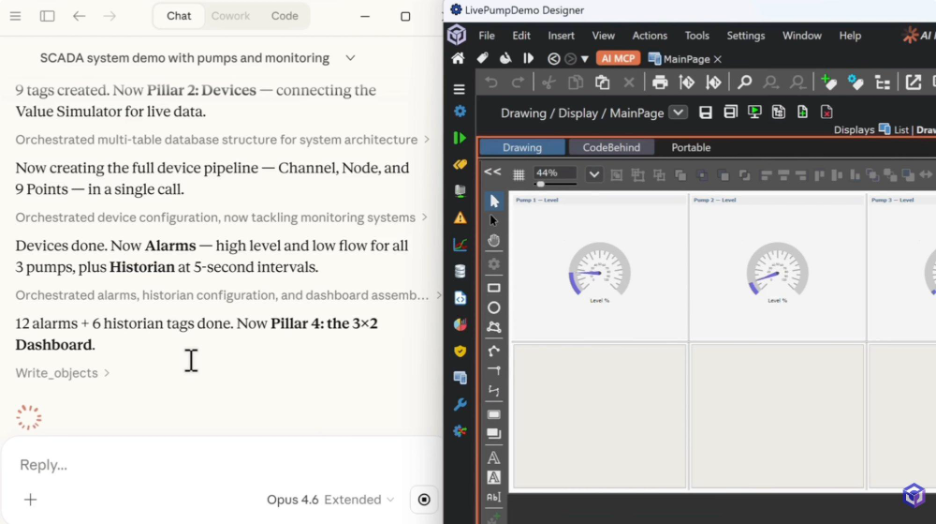
Figure 1: FrameworX AI Designer building a live pump monitoring dashboard from a natural language prompt. The AI creates tags, alarms, historian entries, and display objects in a single orchestrated sequence — no manual configuration steps.
What Changes for Plant Managers
A plant manager at a food and beverage facility has a recurring problem: a production line that hits the same alarm cluster three or four times a week, each time requiring an engineer to investigate. The investigation takes 45 minutes. The engineer produces a report. The manager reviews it the next day.
With AI connected to the live runtime data through FrameworX’s AI Runtime service, the manager opens the system and asks: “What is causing the recurring alarms on Line 3 and what changed in the 30 minutes before each event?” The AI queries the historian, correlates the alarm events with process conditions, and returns an answer. Not a dashboard. Not a pre-built report. An answer, in plain language, in minutes.
This is not a theoretical capability. It is what happens when AI has structured access to live tag values, alarm status, and historian data through a validated interface. The manager did not need an engineer. The engineer was not interrupted. The investigation happened faster than the paper-based version, and the answer was grounded in five years of historian data rather than one engineer’s memory.
What Changes for Operations Teams
Operations teams spend significant time producing reports that regulators, auditors, and internal quality teams require. Batch records. Alarm rationalization summaries. Compliance documentation against IEC standards. In most plants, these reports are assembled manually from historian exports and configuration printouts.
Consider a batch manufacturer preparing for an FDA inspection. The quality manager needs a batch record for every production run in the last 90 days, with alarm events, setpoint deviations, and operator acknowledgments cross-referenced against the process specification. In most plants, assembling that record takes three days. When the SCADA system was built by AI with documentation generated as a byproduct of configuration, the quality manager asks for it and receives it in minutes, accurate to the current project state.
When AI builds the SCADA system, it generates documentation as a byproduct of the build process. Tag dictionaries, alarm rationalization records, asset inventories, data flow documentation. These exist from day one because the AI produced them while configuring the system, not after the fact. When the operations team needs a compliance report, the AI generates it from the current project state. When an auditor asks why an alarm limit is set where it is, the project contains the reasoning the engineer entered when the AI prompted them to capture it.
The documentation debt that plagues most SCADA environments disappears structurally, not through discipline.
What Changes for Maintenance Staff
Maintenance technicians deal with systems they did not build, configured by engineers who may no longer work at the plant, documented in files that may not reflect the current state. Troubleshooting an unfamiliar piece of equipment means hunting through historical alarms, calling the engineer on call, or working from memory.
With AI connected to the running system, a maintenance technician describes what they are seeing: “Pump 2 is cycling on and off every 90 seconds and the flow reading looks wrong.” The AI checks current tag values, reviews the alarm history for that pump, identifies that the same behavior occurred twice in the last 90 days, and tells the technician what was done to resolve it both times. The institutional knowledge that lived in a senior engineer’s head, captured during the build process, is now accessible to anyone who asks.
What Changes for System Integrators
For system integrators, the change is economic before it is operational. A project scoped at eight weeks of engineering time gets delivered in four. That margin improvement compounds across every project the SI runs. More importantly, the SI’s ability to take on projects with junior engineers on the team, supported by AI that carries deep platform knowledge, changes how the business scales.
The projects that previously required two senior engineers because the configuration complexity demanded experience now run with one senior directing the work and two juniors executing with AI assistance. The senior engineer’s time goes to architecture decisions and client relationships, not tag entry. The client gets a faster delivery at higher consistency. The SI gets better margins without headcount growth.
The Organizational Shift
The pattern across these roles is not about convenience. It is about access. AI-native SCADA makes the knowledge inside a system available to the people who depend on that system, not just the people who built it. That is a structural change in what a SCADA platform is, not a feature added to the one you already have.
Author Bio
Marc Taccolini is the CEO of Tatsoft, a SCADA and industrial automation software company. He has spent more than three decades building industrial software platforms and working with system integrators and engineering teams across manufacturing, energy, water, and infrastructure. Tatsoft’s FrameworX platform has over 30 years of development history and is deployed in more than 5,000 installations worldwide. Learn more at tatsoft.com.